

How model configurations work
Model Configurations define the default AI model setup for your organization. Agents use this configuration unless you set agent-level model overrides in the agent settings. To configure models, open Models in your EESI dashboard:- Hosted:
https://platform.eesi.ai/model-configurations - Self-hosted:
http://localhost:3010/model-configurations - Local development:
http://localhost:3000/model-configurations
Model settings are organization-scoped. If no agent-level override is set, every agent in the organization uses the saved global configuration.
Speech to Speech
Use Speech to Speech when you want a realtime model to handle the live spoken conversation directly. In this mode, the realtime model handles speech input and speech output, so you do not configure separate Voice and Transcriber services.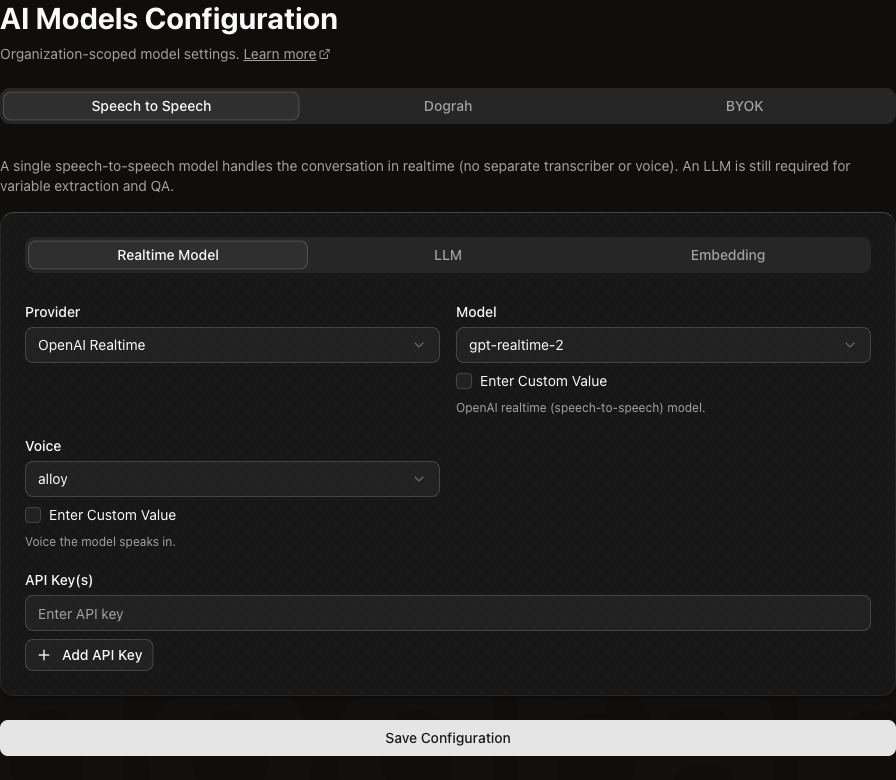 The Speech to Speech section has nested tabs:
EESI
Use EESI when you want the platform to manage the model providers for you. In this mode the deployment’s platform-configured LLM, voice, and transcriber providers are used — you do not enter any provider API keys. On a self-hosted deployment the operator sets these via thePLATFORM_LLM_*, PLATFORM_STT_*, and PLATFORM_TTS_* environment variables (defaulting to local Ollama and Speaches).
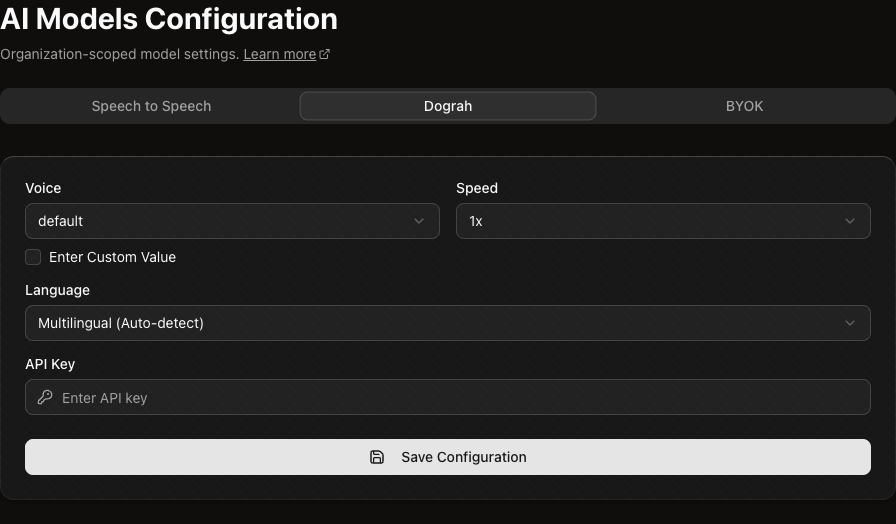 Configure:
BYOK
Use BYOK when you want to bring your own provider accounts and API keys. This gives you separate control over each model category.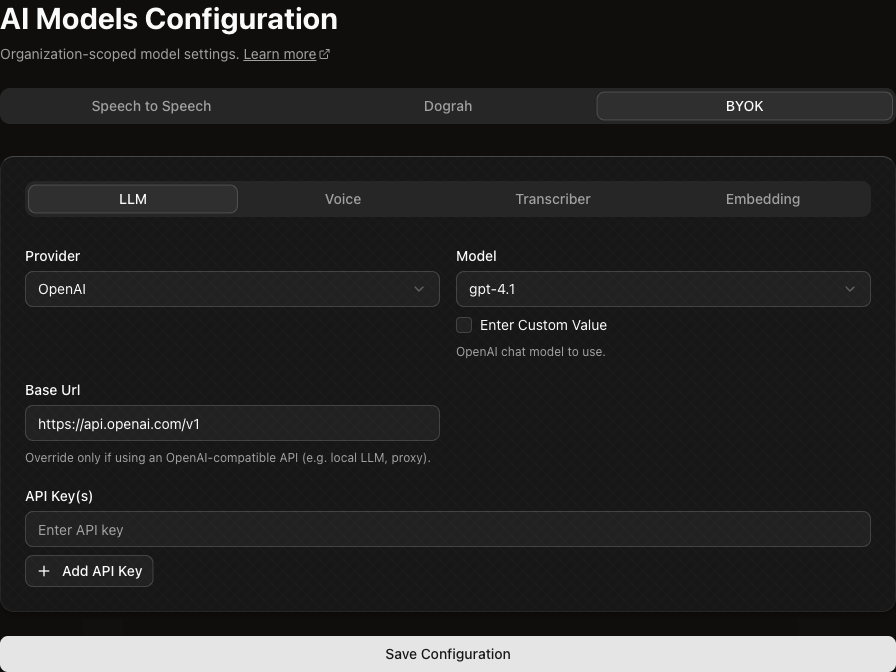 The BYOK section has nested tabs:
Provider-specific fields appear only when they apply. For example, OpenAI-compatible LLM providers can expose a Base URL field, ElevenLabs voices can expose a voice ID, and transcribers can expose language options.
Agent-level model overrides
You can override the organization model configuration for an individual agent. This is useful when different agents need different models, voices, transcribers, or providers. To configure an override:- Open the agent.
- Go to Settings.
- Open Model Overrides.
- Enable the override for the service you want to customize.
- Configure the provider, model, and keys for that service.
- Save the agent settings.